




Shelbyville Chrysler Chrysler Dodge Jeep RAM

Blog / Shelbyville Chrysler Dodge Jeep Ram Dealer

Ram 1500 vs Ram 2500 for Work and Towing in Kentucky

Ram 1500 vs Ram 2500 for Work and Towing in Kentucky

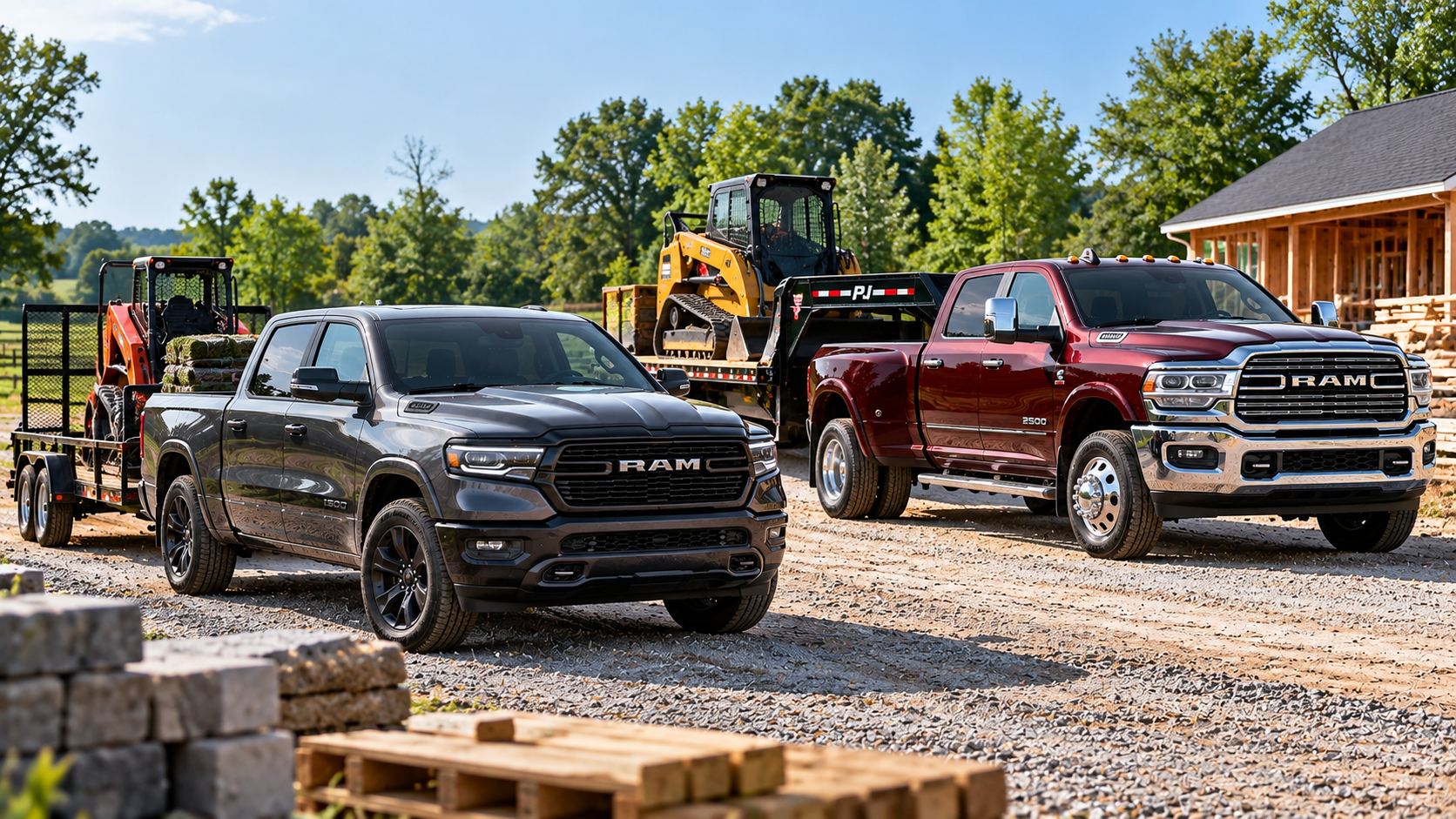
A Ram 1500 vs Ram 2500 comparison starts with the trailer, tools, and passengers you need to carry. Your truck might handle weekday commutes, weekend projects, and occasional trips with a camper. However, heavier equipment can change the amount of towing and payload capacity you need. Which truck belongs in your driveway? The answer involves more than engine power or the size of the truck bed. Understanding how each Ram handles weight, road travel, and trailer connections gives you a stronger starting point.

How Ram 1500 and Ram 2500 Differ for Daily Driving

The Ram 1500 and Ram 2500 use different truck architectures to serve distinct transportation demands. Ram 1500 belongs to the light-duty pickup category. Meanwhile, Ram 2500 uses a heavy-duty frame, suspension, and supporting components for greater available load ratings.

How does that construction change a normal commute? Suspension components support the truck's weight and absorb road movement. The Ram 1500 uses a rear coil-spring suspension, providing a setup suited to passenger travel and everyday hauling. By contrast, the Ram 2500 uses heavier components for increased load carrying.

Consequently, a truck carrying no trailer may feel different from the same truck with equipment attached. Suspension travel, tire specifications, and vehicle weight all contribute to that difference. A test drive without a trailer gives you an opportunity to evaluate steering response, braking, and ride comfort.

Moreover, exterior dimensions deserve attention around Shelbyville. Cab style, bed length, and wheelbase change how much room each truck requires. A Ram 2500 with a longer bed may need additional turning and parking space. However, comparing truck classes alone does not establish exact vehicle length.

Consider the distance between your parking space and nearby walls or vehicles. Additionally, check whether the tailgate can open without contacting another object.

If most trips involve commuting and lighter cargo, the Ram 1500 deserves a close look. When heavier loads occupy a larger share of your driving plans, the Ram 2500 warrants further evaluation.

Understanding Towing Capacity and Trailer Weight

The 2026 Ram 1500 offers up to 11,610 pounds of maximum available towing capacity. Meanwhile, the 2026 Ram 2500 reaches 20,000 pounds with its available Cummins diesel engine.

These numbers represent manufacturer maximums for specific configurations. They do not describe the towing rating of every truck bearing either name.

How should you compare those ratings with your trailer? Start with its weight after you load it for travel. A camper's empty weight does not include everything you may add before leaving home. Water, equipment, food, and personal belongings contribute to the final trailer weight.

Furthermore, the truck must remain within its gross combined weight rating, or GCWR. This rating limits the combined weight of the loaded truck and loaded trailer. Therefore, an acceptable trailer weight alone does not establish that the entire combination meets every limit.

Before narrowing your truck choice, confirm three towing details:

  • Loaded trailer weight: Include cargo, equipment, and supplies when comparing the trailer against the truck's published towing rating.
  • Trailer connection: Identify whether the trailer uses a conventional hitch, fifth-wheel connection, or gooseneck arrangement before selecting towing equipment.
  • Truck configuration: Check engine, axle ratio, cab, drivetrain, and installed trailering equipment against the manufacturer's towing guide.

Additionally, the trailer's braking equipment and the truck's receiver rating need verification. A higher engine output cannot override the limits of the hitch or other components.

For larger fifth-wheel or gooseneck trailers, the Ram 2500 provides purpose-specific towing equipment. Still, verify the trailer's loaded weight and hitch requirements before choosing a particular heavy-duty configuration.

Comparing Payload and Worksite Loading

Towing capacity measures how much trailer weight the truck can pull within its published limits. Payload addresses how much weight the truck itself can carry.

The 2026 Ram 1500 offers a maximum available payload rating of 2,360 pounds. By contrast, the 2026 Ram 2500 reaches 3,930 pounds with the 6.4-liter HEMI V8.

However, the maximum payload configuration is not necessarily the configuration with the highest towing rating. Cab, engine, drivetrain, and installed options change the available capacity.

Why can a truck meet its towing limit but exceed its payload limit? Trailer tongue weight transfers part of the trailer's load onto the tow vehicle. Passengers, tools, bed cargo, and hitch hardware also contribute to the weight the truck carries.

For a work truck, these details deserve separate attention:

  • Passengers and personal belongings: Include everyone riding in the cab and the items they bring when estimating truck loading.
  • Tools and bed cargo: Account for equipment, materials, storage boxes, and accessories that add weight to the pickup.
  • Tongue or pin weight: Include the load transferred from the trailer connection when checking available payload and axle ratings.

Consider a truck that carries four passengers, jobsite tools, and a loaded utility trailer. Even if the trailer falls below its towing limit, the combined truck load could exceed the remaining payload allowance.

Therefore, review the vehicle's door-jamb certification and tire-loading labels alongside Ram's towing documentation. Gross vehicle weight rating, or GVWR, limits the truck's total loaded weight. Gross axle weight ratings set separate limits for each axle.

A Ram 2500 may provide additional room within these ratings. Nevertheless, its higher advertised maximum does not eliminate the need to calculate the actual load.

Choosing Gas or Diesel for Work and Travel

Engine selection changes more than the number printed beside horsepower. It also shapes torque delivery, fuel requirements, towing equipment, and the truck's operating routine.

The 2026 Ram 1500 offers gasoline engines, including the Pentastar V6, Hurricane inline-six variants, and HEMI V8. The 2026 Ram 2500 offers the 6.4-liter HEMI V8 and available 6.7-liter Cummins turbo diesel.

What separates a gasoline engine from a diesel when pulling a trailer? Torque is the turning force an engine produces. Diesel engines can provide substantial torque at lower engine speeds, which is useful when moving heavier loads.

The available Cummins in the 2026 Ram 2500 produces up to 1,075 pound-feet of torque. Additionally, its maximum available towing rating reaches 20,000 pounds. The gasoline HEMI V8 provides a separate option, with up to 17,750 pounds of towing capacity.

However, diesel selection introduces other ownership requirements. Modern diesel trucks use emissions equipment that may require diesel exhaust fluid. Fuel costs, maintenance schedules, and service requirements also warrant review.

For shorter commutes with occasional trailer use, a gasoline configuration may deserve attention. Furthermore, Ram 1500 offers several gasoline powertrains without requiring a move into heavy-duty construction.

When towing large loads forms a substantial part of your routine, compare the Cummins-equipped Ram 2500. Still, verify the specific truck's towing and payload ratings before treating engine torque as the deciding factor.

Comparing Ram Trucks Available in Shelbyville

Once your towing and hauling requirements are clear, compare actual truck configurations. A Ram 1500 vs Ram 2500 decision should account for the work you plan to complete each month.

Begin with the trailer's loaded weight and the cargo carried inside the pickup. Then compare the truck's manufacturer ratings with those requirements. Additionally, review your parking space and the driving distance you cover without a trailer.

Before selecting an available truck, confirm these details:

  • Weight ratings: Review the towing guide, payload information, GVWR, and axle ratings for the engine and configuration under consideration.
  • Equipment and dimensions: Verify cab layout, bed length, drivetrain, hitch equipment, and any installed trailering packages.
  • Actual inventory: Compare the listed truck's configuration with your requirements, then confirm availability before arranging a visit.

Shelbyville Chrysler Dodge Jeep RAM provides a starting point through its new Ram trucks listings. You can also examine used Ram trucks for additional configurations and model years. The dealership's new vehicle inventory offers another way to explore available pickups.

Before your visit, gather your trailer specifications and a list of the tools or equipment you carry. Bring those details when comparing trucks at Shelbyville Chrysler Dodge Jeep RAM. Test the seating position, inspect the hitch equipment, and review the manufacturer's ratings for each finalist. Your next truck should handle the loads you plan to carry and the miles between jobs.
Posted in:

Related Posts

Jeep Grand Cherokee Trim Levels for Kentucky Drivers

Jeep Grand Cherokee Trim Levels for Kentucky Drivers

Choosing between Jeep Grand Cherokee trim levels means deciding which driving, seating, and technology features deserve space on your list. Your morning drive through Shelbyville might call for a different setup than weekends crossing Kentucky with family and gear. Which trim gives you the equipment you will use? The answer begins with the difference between trim names, drivetrains, and seating layouts. Those choices shape the way a Grand Cherokee fits your plans. Understanding the Grand Cherokee Trim Lineup The 2026 Grand Cherokee lineup begins with Laredo and moves through several equipment grades toward Summit. Jeep lists Laredo, Laredo X, Laredo Altitude, Limited, Limited Reserve, and Summit. In addition, an 85th Anniversary Edition adds another configuration for shoppers to investigate. However, the list is more useful when you understand what each step changes. What separates an entry trim from an upper trim? A trim groups factory equipment into a named configuration. For this reason, the Laredo establishes the starting point for comparing standard cabin features and the V6 engine. Laredo X adds another equipment choice, while Laredo Altitude introduces a distinct appearance and feature combination. Therefore, read the equipment list before assuming a trim name guarantees a particular feature. Additionally, Limited shifts attention toward seating appointments and cabin conveniences. Limited Reserve extends that approach with another package of upgrades. Summit occupies the upper end of the lineup with more extensive interior and available mechanical equipment. Still, trim names alone do not reveal every option on a specific SUV. Three comparisons make that progression easier to evaluate: Laredo and Laredo X: Start with their equipment lists to see which essential cabin features already meet your travel plans. Laredo Altitude and Limited: Examine these configurations carefully, since styling changes and comfort upgrades address different priorities. Limited Reserve and Summit: Review their equipment individually, since upper trims may add both interior details and driving hardware. Additionally, Grand Cherokee body styles require a separate decision. The standard Grand Cherokee has two seating rows, while Grand Cherokee L has three. A higher trim does not automatically add a third row. Confirm both the trim and body style before evaluating passenger space. Engine and Four-Wheel-Drive Differences Across Trims The Grand Cherokee's engine and drivetrain deserve their own comparison. Furthermore, the 2026 Laredo and Laredo X use a 3.6-liter Pentastar V6 producing 293 horsepower. Jeep also introduces a 2.0-liter Hurricane 4 Turbo, rated at up to 324 horsepower. However, engine availability varies by trim and configuration, so the listing must identify the actual powertrain. How does that choice change your drive? Engine output describes power, while torque describes turning force delivered through the drivetrain. Additionally, the Hurricane engine produces up to 332 pound-feet of torque. Consequently, comparing horsepower alone leaves out how the engine delivers force during acceleration or highway merging. A test drive can reveal which response suits your preferences. Four-wheel drive raises another question for Kentucky travel. In contrast, a 4x4 drivetrain can send power to both axles, supporting traction when surfaces become slippery or uneven. However, 4x4 does not shorten stopping distance or replace suitable tires and careful driving. Check which traction equipment accompanies the exact trim under consideration. Before selecting a drivetrain, consider these distinctions: 4x2 versus 4x4: Compare configurations based on your usual roads, steep driveways, and occasional unpaved destinations. Transfer cases and traction settings: Check the installed hardware, since different 4x4 arrangements control power distribution in different ways. Tires and suspension: Verify tire specifications and available air suspension, since these components change ground clearance and road contact. Jeep offers Selec-Terrain settings and available Quadra-Lift air suspension on qualifying configurations. Selec-Terrain adjusts vehicle controls for selected surfaces; air suspension can change ride height. Therefore, neither should be treated as a standard feature on every Grand Cherokee. Look for the exact equipment listed for the SUV you plan to drive. Interior Comfort and Technology Worth Comparing Cabin upgrades can separate Grand Cherokee trims just as clearly as engine or traction choices. Limited adds several appointments beyond the starting models, including equipment that varies with configuration. Summit introduces further seating and technology features. However, the useful question is whether those additions fit your passenger routines. Which upgrades stand out during a commute? Consider the surfaces you touch and controls you use on every trip. Heated seating can make cold Kentucky mornings more comfortable, while ventilation may matter during summer trips. Furthermore, power seat adjustments are worth evaluating when more than one person drives the SUV. Moreover, the 2026 Grand Cherokee offers a 12.3-inch Uconnect 5 NAV touchscreen with smartphone integration. Even so, check the actual screen, navigation, and connected features shown on the vehicle's window sticker. The presence of a touchscreen does not establish every optional technology package. Therefore, on Limited, investigate the upholstery, rear-seat heat, ambient lighting, and available audio equipment. Summit raises the cabin specification with features such as massaging front seats and McIntosh audio. Compare seat support and controls during a stationary demonstration before focusing on speaker counts. For family travel, make sure passengers can reach their seats and use cabin storage without difficulty. In addition, the Grand Cherokee L adds a third row through a longer body configuration. By contrast, buying a more expensive two-row trim will not create another passenger row. Match seating needs first, then narrow the cabin features that matter. Matching Grand Cherokee Equipment to Your Driving Plans A trim decision becomes clearer when you consider a normal week behind the wheel. For instance, a Shelbyville commuter may spend most trips on paved roads. Another household may carry children, luggage, or outdoor equipment across Kentucky. Consequently, the same trim upgrade may deserve different attention in each household. How should commuting shape your shortlist? Start with seating comfort, visibility, parking ease, and the controls you operate each day. If you share driving duties, compare memory settings and seat adjustments where equipped. Additionally, test the infotainment controls while parked so you understand their operation before driving. For family travel, passenger count comes before interior trim materials. A two-row Grand Cherokee seats five, while the Grand Cherokee L provides three rows. However, added seating changes the cargo area available with passengers aboard. Inspect the rear storage area with the seats positioned as you intend to use them. Furthermore, long trips introduce another set of questions. Do you need to carry luggage behind occupied seats, drive on unpaved access roads, or tow a trailer? Those needs direct attention toward cargo measurements, 4x4 equipment, and the specific vehicle's trailering rating. Therefore, verify those figures for the exact engine, drivetrain, and installed equipment. Laredo may meet your requirements without every upper-trim convenience. Limited may appeal if seating and cabin upgrades have a clear place in your routine. Summit deserves a closer look when its specific equipment matches what you plan to use. Instead of treating the highest trim as the default choice, test the features that distinguish your finalists. Comparing Grand Cherokee Trims Available in Shelbyville Once you understand the Jeep Grand Cherokee trim levels, compare actual vehicles instead of relying on general trim descriptions. In addition, equipment can vary with drivetrain, packages, seating layout, and model year. Moreover, an online listing may not show every installed feature in its summary. What should you confirm before choosing a Grand Cherokee? Check the vehicle's window sticker or equipment listing against your must-have features. Then verify its engine, 4x2 or 4x4 configuration, and number of passenger rows. Therefore, a trim label provides a starting point, but the individual vehicle provides the final answer. Use this short checklist while reviewing listings: Mechanical configuration: Confirm the full trim name, engine, drivetrain, and two-row or three-row body configuration for each vehicle you shortlist. Cabin equipment: Compare seating materials, climate features, infotainment equipment, and driver assistance features against the items you intend to use. Available inventory: Check current availability and request the original window sticker when a feature or optional package needs confirmation. You can explore current options through Shelbyville Chrysler Dodge Jeep RAM's new Jeep inventory page. The dealership's broader new vehicle inventory offers another route for reviewing listings. If a preferred trim or configuration is unclear, contact the dealership to verify the equipment on a specific vehicle. Finally, bring your passenger needs, driving routes, and top feature choices to your visit. Sit in the driver's seat, try the cabin controls, and compare the two configurations that meet your requirements. That approach gives you a clearer reason to choose one Grand Cherokee trim over another.